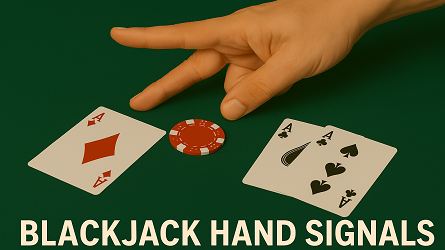
Blackjack Hand Signals: Easy Guide for Beginners
When playing blackjack at a land-based casino, verbal instructions alone aren't enough—you must use clear blackjack hand signals. These simple gestures communicate your decisions to both the dealer and security cameras, making your moves clear and verifiable.
This beginner-friendly guide covers essential blackjack hand signals clearly and concisely. Whether it's your first game or you're refreshing your skills, mastering these signals is crucial.
Why Blackjack Hand Signals Matter
Hand signals are mandatory in casinos because:
-
Security: Cameras record gestures to prevent disputes.
-
Clarity: They clearly show your intentions to the dealer.
-
Consistency: Reduce misunderstandings or cheating.
Verbal commands like "hit" or "stand" are insufficient. Casinos rely solely on your gestures, making them vital to master.
Essential Blackjack Hand Signals Explained
Here are the standard gestures for each action:
Hit - Tap the Table

To request another card, tap your finger lightly on the table beside your cards. Use when your hand total is low (e.g., 12 or 13).
Stand - Wave Hand Horizontally

To indicate no more cards, wave your hand side-to-side, palm down. Ideal with strong totals (e.g., 18, 19, or 20).
Double Down - Add a Chip and Point

To double your bet for one more card, place an additional chip next to your initial wager, then point at your cards. Commonly used with totals of 9, 10, or 11.
Split - Form a V with Fingers

To split pairs, place an extra chip beside your original bet and hold a V-sign above your cards. Useful when dealt pairs (e.g., two 8s or Aces).
Surrender - Draw a Line Behind Cards

To surrender and regain half your bet, draw a horizontal line behind your cards using your index finger. Typically chosen with weak hands against strong dealer cards (e.g., 16 vs. dealer’s Ace).